Having a working prototype is good news, but it doesn’t mean the part is ready to be mass-produced. What was made by hand, on a 3D printer, or in a machining center to validate an idea can rarely be replicated exactly at an industrial scale without the cost skyrocketing or the quality suffering. The leap from prototype to mass production It is, in reality, a project in itself, with its own technical decisions and common pitfalls. Understanding what it entails helps in planning it well and avoiding surprises when commitments to clients are already in place.
Why can’t the prototype be manufactured as is?
A prototype answers one question: Does it work? An industrialized part answers a very different one: Can it be manufactured a thousand times identically, at a reasonable cost, and without any failures? These are different objectives, and therefore the part usually has to change between one phase and the other.
The first reason is the manufacturing process . A machined prototype can have very tight internal radii, variable thicknesses, or geometries impossible to achieve through stamping or deep drawing. When it’s to be press-machined, each of these details has to be reviewed: the radii are widened, the thicknesses are standardized, and the shapes are adapted to what a die can produce in a single operation or in several. The final result functions the same, but it’s not exactly the same part.
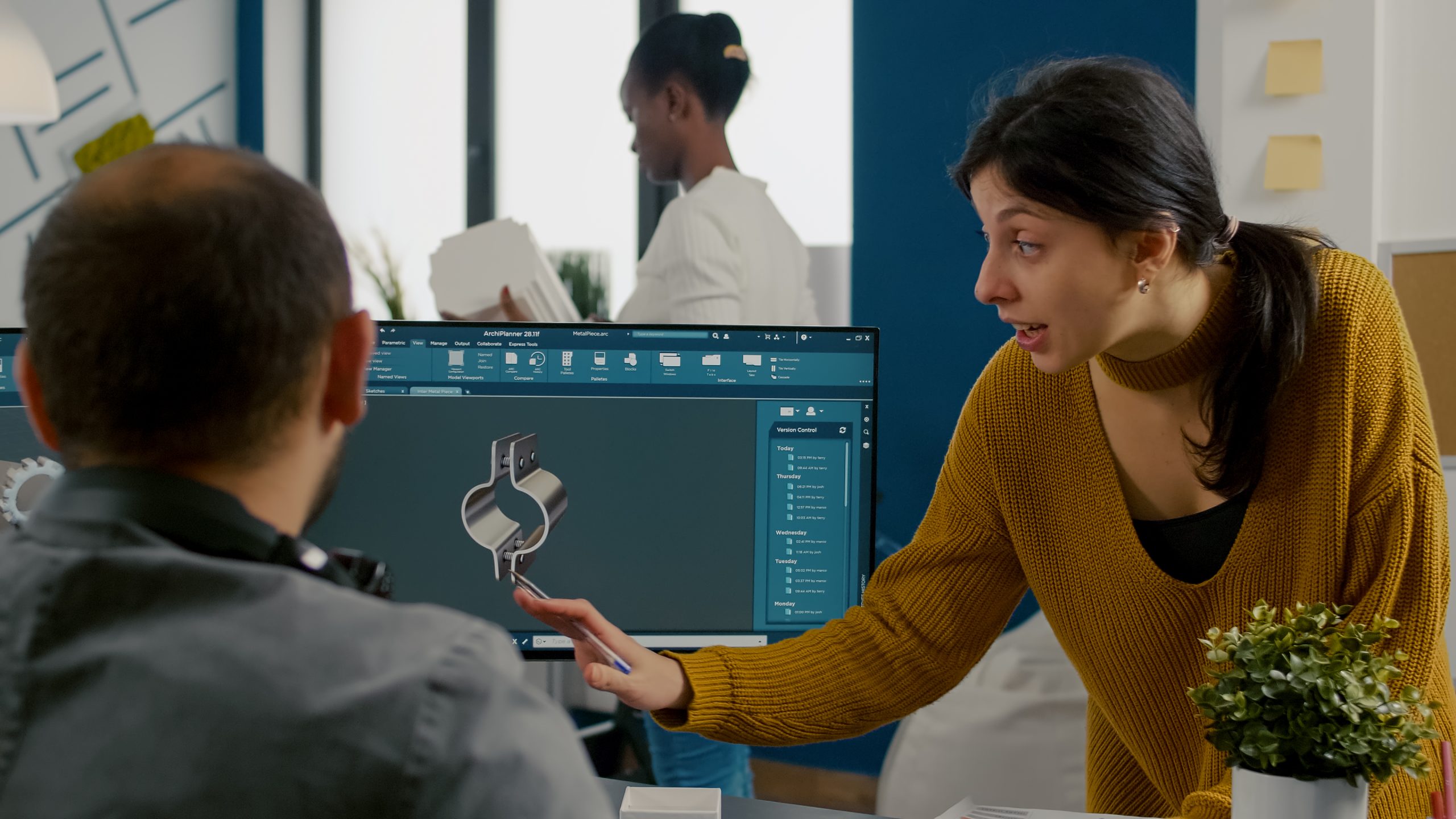 The second reason is the material . It’s common for the prototype to be made from generic steel or aluminum because that’s what was available in the workshop, without much thought given to how that material behaves when stamped, folded, or drawn. For production, a specific grade must be chosen, with a commercially available thickness and forming properties that allow for manufacturing without cracks or burrs. Sometimes a change of material reduces the cost of the part more than any redesign.
And the third reason is tolerances . In a prototype, everything tends to be specified with great precision because it costs nothing to write it on the drawing. In mass production, every hundredth of a tolerance that isn’t strictly necessary increases the cost of the process, requires more quality control, and generates more rejects. Industrializing a part is, to a large extent, about deciding which dimensions really matter and relaxing the ones that don’t.
All of this explains why the manufacturer that will produce the series should join the project before the prototype is finalized. The later they get involved, the more changes will be needed and the more expensive each change will be.
The decisions that shape the industrialization process
Once it is clear that the part will be adapted, the industrialization process of parts goes through three decisions that determine the unit cost and the initial investment.
The first factor is the projected volume , not just the initial order, but the cumulative total over the product’s lifecycle. For a few thousand pieces, a process with simple tooling and more manual operations might be more cost-effective; for hundreds of thousands, a progressive die that produces a finished part with each press stroke quickly recoups its cost and reduces the unit price to a fraction. Making the wrong choice here is costly in both directions: investing in a complex die for a short run, or being stuck with a slow process when demand takes off.
The second one is the tooling designIn stamped or drawn parts, the die is what manufactures the part; the press only delivers the impact. Therefore, die design encompasses a significant portion of the project’s knowledge: it defines how many operations are needed, what part of the sheet metal is reused and how much material is wasted, how critical tolerances are controlled, and at what production rate. When the manufacturer design and build your own progressive matrices Instead of outsourcing them, the adjustments between part design and tooling design are resolved at the same table, and that greatly shortens the setup time.
The third step is the control plan . You must decide what to measure, how often, and by what means before production begins, not after the first problematic batch. For critical parameters, a pass/fail gauge or a specific control tool is usually required; for the rest, sampling is sufficient. Defining this plan well prevents both excessive inspection and the risk of a defect reaching the customer.
These three decisions are interdependent, and that’s why it’s best to make them together, with the manufacturer present and the plan open.
From pre-series to stable production
Knowing how to go from prototype to series doesn’t end with building the mold. Between the initial press coverage and stable production, there’s an intermediate phase that many projects underestimate: the pre-series .
The pre-production run is a small batch, of a few dozen or a few hundred pieces, manufactured using the final tooling and the actual process. It serves to verify that the die delivers the expected dimensions, that the material behaves as anticipated, and that secondary operations, such as threading, welding, or assembly, fit the stamped part. It is also the time to validate the part with the customer during its actual assembly, because some problems only appear when the part is joined with the others.
It’s normal for pre-production to reveal minor adjustments: a radius that needs tweaking, a die pitch that requires more clearance, a tolerance that was tighter than the function demanded. Making these changes now, on dozens of parts, is cheap. Making them later, with thousands already manufactured, is not.
Once the pre-production run is validated, the process is documented: press parameters, control guidelines, material references, and, if applicable, the die modification history. This documentation is what guarantees that the fifty-thousandth piece will be identical to the first, even if the operator changes or a year passes between orders.
Coordinating all these phases, from reviewing the plans to delivering the first batch, is simpler when a single person manages the project and is familiar with both the part and the factory. our industrial project management service We assume precisely that role: we analyze the prototype with a productive approach, propose the changes that make it manufacturable, develop the tooling and accompany the pre-series until the piece is in stable production, without the client having to change contacts or suppliers along the way. To industrialize a metal part Doing it right isn’t just about manufacturing faster: it’s about reaching the production stage with a part that’s better than the prototype it came from.